
Aquarium Planaria; Wiggly Detritus Worms, in Tank Water, on Glass
AQUARIUM PLANARIA OR ACTUALLY DETRITUS WORMS?
Updated 9/18/23
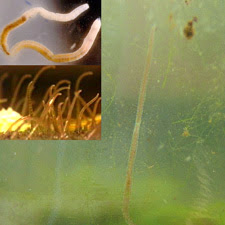
Detritus Worms (to the left)
This post was/is inspired by the many questions I have read or been asked from readers of my articles, conversations, or forum members (Everything Aquatic in particular) as to Planaria, which most of the time have been mis-identified via "cut and paste" Internet articles found on websites such as eHow, then repeated all over the Internet in the many anecdotal forums, despite the fact there are many true experts with decades of experience out there that could be consulted.
Referenced aquarium/pond keeping forum:
Everything Aquatic Aquarium Forum
WHAT ARE THE FACTS & THE IMPORTANCE OF THESE FACTS AS IT RELATES TO HOW TO DEAL WITH THESE WORMS:
The facts are that 85-90% of the time these thin as a hair and white worms that persons sometimes even see swimming though the water in the middle of the aquarium are instead Detritus worms which are an "Annelid" not even closely related to Planaria (which are flat worms).
As well many of these sites, even when correctly identifying these worms, are incorrectly stating their cause such as over feeding which is true for Detritus worms, but generally not Planaria!!!
This mis-identification and confusing of treatments did not even exist (that I knew of) prior to the Internet. However with the plethora of persons writing articles with little or no expertise on the subject in an attempt to boost Internet exposure for their client's web site, this problem began.
Then after Google algorithm changes that weighted so called authority sites and social media, these bad articles rose to the top. Of late, now we have circular internet and social media forums now spreading full or mixed truths about Planaria & Detritus worms, their causes, what they feed on, and treatment. Unfortunately it seems that aquascaping forums of late are leading the way here with mixed information.
As an example, I had a client looking for help. Unfortunately she went to a fish forum and bad Internet articles (I will cite these later in this article), the result of one incorrect identification resulted in her killing off many of her fish.
She followed the advice given to her to treat with Levamisol, this was based on a forum members suggestion after reading one of the many incorrect Internet articles that the search engines love to serve up.
ADVERTISEMENT
I have also read many "horror" stories while browsing through forum posts whereby they were initially convinced they had a problem with planaria in their tanks after being told by many other fish keepers, aquariums stores or by searching on the internet.
This has resulted in snake oil products for non existent problems to emerge such as "No Planaria" (sold by "Green Leaf Aquariums" which Google's now terrible algorithm changes have brought to prominence).
What was the result? This resulted in a massive die off of the Detritus worms that quickly depleted the water of oxygen (which was already somewhat depleted due to the causes of the worm population explosion), as well as a sudden spike in ammonia, thus taking out the fish as well.
In other instances I have read many forum posts where the person posting were initially adding products such as "No-Planaria" purchased from businesses more than willing to take their money for an imaginary problem. This often led to double doses of these meds resulting is stressed fish since they are not best remedy for what these worms really are; DETRITUS WORMS.
The facts are, while Planaria MAY be dangerous to fish Detritus Worms are not and a population surge indicates other issues that are best addressed without medication use, NOT THE USE OF LEVAMISOL, "NO-PLANARIA", OR OTHER TREATMENT!!!
Detritus worms are generally only dangerous when oxygen levels are low with high bio loads where they compete with fish for oxygen. Some persons have claimed these worms have attacked their fish or shrimp, but in every case I have been sent pictures or made a house call, the worms were Planaria or more often indeed Detritus Worms, but were simply doing what a decomposter (detritivore) does; scavenge a dead or nearly dead fish or shrimp!!
The point is, the problem with this confusion of these two very different worms IS IMPORTANT since infestations of each of these different worms has very different implications for your aquarium, So Please Read On!
What are Detritus Worms?
These Detritus Worms are normally not a problem and often go un-noticed aiding in breakdown of wastes while living in the gravel or filter media (such as sponges, bio balls, etc.). In fact these worms are generally beneficial in aiding in larger waste breakdown, as well these worms can even be a healthy food source for fish.
However when the population explodes these worms often leave the gravel and cling to the sides, usually close to the surface as oxygen depletion due to the cumulative effects of increased organic mulm, cloudy water and simply too many Detritus worms drive them from the oxygen poor gravel.
The population explodes generally due to high amounts of decomposing organic mulm (often resulting in cloudy water, pH drops, etc.), which is often an indicator of a tank with one or usually more of these problems:
- Poor filtration
- Poor cleaning practices
Reference: Aquarium Cleaning, methods, reasons, more - Too high of a bio load (number of fish, etc.)
- Poor bio filtration or simply poor bio filters (Sponge Filters, or Fluidized Sand Bed Filters are the most efficient bio filters)
Product reference links: PREMIUM Aquarium Sponge Filters; Model #3 & Fluidized Sand Bed Filter; Highest bio capacity aquarium filters - Poor Redox Balance
Reference: The Aquarium Redox Balance and its importance to good fish health - Poor feeding practices (not always over feeding, sometimes simply feeding foods that do not digest well) and other reasons as well.
Reference: Proper Fish Nutrition
Treatment/Removal of Detritus Worms
Generally just improving the above noted factors will lower your detritus worm numbers to where they will again go un-noticed and be at much safer numbers for your aquariums bio load capacity.
Complete removal is not necessary and generally not even recommended since these are excellent decomposters.
Generally when you see these worms emerging is when the oxygen levels are depleted in the substrate and these worms are seeking oxygen, so chemical treatment as generally for Planaria will further deplete oxygen and thus further deplete oxygen, often killing fish too.
I should note that often during power failures, these worms will then emerge seeking oxygen even when your tank has an otherwise well managed bio load.
For further information about the subject of worms, please see my Aquarium Answers Article:
* “Aquarium Answers; Trematodes and Nematodes in Aquariums” which includes information about these worms near the bottom of the article.
Detritus Worms Video
Planaria (below)
 As for Planaria versus Detritus Worms, no one has bothered to check with any zoological, biology or similar research site.
In the case of Detritus Worms (being identified as Planaria), I checked several sources to confirm what was a baffling amount of poor information in aquatic sites, yet all the biology sites confirmed the rather obvious difference between Planaria and Oligochaetes Worms (the family of worms that compost in water that includes tubiflex, naidid, and similar worms).
Planaria are tiny flatworms that live in freshwater and marine environments, and on plants throughout the globe.
Planaria we do occasionally observe in aquariums are more naturally found fresh water ponds or temperate lakes, and are carnivores or scavengers (scavengers. in the sense of a vulture, most definitely NOT a decomposter)!
Another key point about Planaria is these flatworms are generally only seen in VERY small numbers of individuals, unlike Detritus Worms which can number in the 100s or more.
Further Planaria Information:
The pharynx (the passageway leading from the oral cavity in the head to the esophagus) can be protruded from the mouth which is in the middle of the ventral side of the animal. The diet consists of such foods as insect larvae, small crustaceans, and other small living and dead animals, NOT decomposing matter as Detritus Worms do.
Planarias reproduce asexually and sexually; individuals have both testes and ovaries.
A single one can be cut into hundreds of pieces and each will grow back into a whole planaria —a remarkable feat of regenerative capacities.
The implication of a true Planaria infestation is VERY different from the much more common Detritus worm infestation, which is why this correct identification is so important.
Planaria can harm some fry, fish eggs, or even occasionally resting or weak fish, and are generally not an indicator of a dirty aquarium as is the common myth.
Planaria is normally transferred into an aquarium from live plants normally grown in a pond. Generally ponds have more incidence of Planaria.
Where as Detritus Worms are primarily decomposters (detritivores) that cause little harm unless their population explodes which then they compete for oxygen with fish and are an indicator of poor tank conditions in general. When Detritus worms are out from the gravel crawling on the glass, etc, this is a sign of a “dirty aquarium” with implications of high amounts of mulm and lower dissolved oxygen as noted earlier.
Under NORMAL conditions, Detritus worms are no more harmful to you or your aquarium inhabitants than an earthworm is to you and your garden!
Removal (Treatment) of Planaria, which unlike Detritus worms SHOULD be totally eliminated
There are several remedies that can rid a tank of Planaria, which the positive with treatment elimination is since Planaria are generally only found in very small numbers, the die off not cause a problem decreased oxygen or toxins released (unlike snails, detritus worms, etc.).
Here are a few:
*Clout; this is one of the most effective treatment blends which contains:
4-[p-(dimethylamino)-)O-Phenylbenzylidene]-2,5-cyclohexadien-1-xylidene dimethylammonium chloride; dimethyl (2,2,2-trichloro-1-hydroxy-ehtel) phosphonate; 1,2-dimmethyl-5 nitromidazole and inert ingredients as non toxic binders.
A negative of this treatment is it cannot be used with Piranhas, Metynnis species, scalelesss fish, bottom feeders, Marine Sharks, or Lion Fish.
Product Reference: Aquarium Products Clout Parasite Treatment
*Trichlorfon (Dylox); found in AAP Dyacide. This is one of the most pure products for treatment of most all external multi cell parasites including Planaria, Flukes, & Anchor Worms.
With the demise of Clout, "AAP Dyacide" is now the only truly effective treatment now available.
Product Reference: AAP Dyacide (Pharmaceutical Grade Dylox)
*General Cure; Not as strong, but still often effective and less harsh on delicate fish. General Cure contains Metronidazole & Praziquantel
Product Reference: API Mars Fish Care General Cure Parasite Treatment
*Levamisol
*Copper at .25 ppm MAY be effective for Planaria
*Be wary of many wormers not normally meant for aquatic use, that may work, but dosing can be tricky and over dosing has happened.
*Often ParaGuard or Flubenol is recommended, but using it is only mildly to moderately effective on Detritus Worms and rarely is effective for true planaria
Other references:
*https://www.exploratorium.edu/
*https://www.baruch.cuny.edu/
Aquarium Parasites, Nematodes, Trematodes, Planaria, more
SUMMARY
What is so disgusting about the confusion of Detritus Worms with Planaria is the fact that this confusion did not exist prior to the Internet.
Quite frankly these two 'animals' have about as much in common as an opossum and elephant, so the fact that so many are this gullible and search engines such as Google in particular are this bad SPEAKS VOLUMES!!
What has happened is apparently someone posted this extreme mistake and others then being lazy, simply re-posted it over and over with terrible spam websites such as about.com then also spamming it further.
Correct information used to "rise to the top" of Google searches for "Aquarium Planaria", but with all this spam with the same exact incorrect information, the newer Google algorithms have labeled the truth as spam and spam as truth..... so much for trusting a your "Googling"!!!
As well, with Facebook forums such as "Fish Tank Enablers" run by anecdotal disrespectful moderators with no understanding of scientific method or respect for mentoring, myths such as this further get pushed along.
Examples of other myths:
Common Aquarium Keeping Myths
Another purpose of this post/article is to bring attention to readers (who keep and maintain aquariums and ponds) to be careful about believing everything written, blogged, etc. here on the internet when it comes from some aquatic sites.
What I have noticed being in the maintenance and also research side of this business is that someone will write and anecdotal article with no research behind it and then others will pick this up and run with this poor information. This is especially common with information spam sites like about.com which were created purely for advertising revenue.
INTERNET MISINFORMATION ABOUT PLANARIA:
Here are a couple of "Gems" from eHow.coms misinformation campaign:
Quotes: "Planaria thrive in freshwater aquariums that are not properly cleaned or contain lots of excess food at the bottom".
AND: "Many freshwater fish enjoy eating these worms. Although the worms are not harmful to the fish, the conditions in which they thrive can be fatal. Planaria can even get into the gills of fish, causing irritation. While filling your tank with Planaria-eating fish can take care of a few worms, the overall conditions that allow Planaria to grow must be treated so no harm will come to the fish".
FACT: There are FEW fish that will eat true Planaria!
There are NO conditions that cause a Planaria outbreak, only Detritus Worms, sorry eHow, Planaria are carnivores!
This whole article at eHow revolves around Detritus Worms even though the heading is about Planaria.
The other part of this confusion by these “cut and paste” sites/articles is even when correctly identified, Planaria are still attributed to the same water conditions that cause a Detritus Worm population “explosion” which is simply not true and can lead an aquarium keeper to address non existent problem if they believe this misinformation from sites such as Aquarium Wiki or planetinverts.com.
Planetinverts.com in particular is a website that correctly identifies Planaria, but then goes on to describe the remedy for a Detritus worm out break. The danger here is if you truly do have a Planaria infestation, just lowering bio load, feeding, etc., will NOT work, so this web site is placing the aquarium keepers fish, shrimp, etc in danger with such poor information.
Summary of Misinformation provided by Google Search Results!
Here are just a few of the websites with misinformation on this subject & more
*www.onedersave.com/ (This is simply a "Cut & Paste" site with no research!!)
*www.fishdeals.com/fish_diseases/planaria_white_worms/
*www.aquariumfish.net/information/having_trouble_p2.htm
*www.theaquariumwiki.com/Planaria
*www.aquaticplantcentral.com/forumapc/general-aquarium-plants-discussions/67061-planaria-surprise.html
*www.planetinverts.com
*Yahoo Answers
*Aquarium Wiki
*Aquarium Fish.Net
*Fish Deals
*About.com
*FishLore
*www.cuteness.com/article/aquarium-fish-eat-planaria
As well many persons often think that Wiki has it correct, yet they are dead wrong and even misidentify the type of worm these are calling them a nematode as well as stating they "feed on dead and decaying organic materials"
*Flatworms
In Closing as to Aquarium Keeping Misinformation in General; Besides experience I have gained in the maintenance business, research, seminars, I still do not assume that what I know is correct and re-research often and I often research out side the aquarium industry in areas such as microbiology, the lighting industry, medical, and other research and outside industry sites.
 There are several more subjects with vast amounts of poor information, such as nitrifying bacteria, what they are, can they be packaged and whether or not antibiotics will kill them.
The fact here is that true nitrifying bacteria belong to the family Nitrobacteraceae and REQUIRE oxygen and are gram positive bacteria that react to gram positive treatments while most pathogenic bacteria in aquatics (freshwater and even more so in saltwater) are pure gram negative bacteria. This means that these bacteria can live short periods at room temperature in a liquid.
Reference: Aquarium Nitrogen Cycle; Nitrification & Nitrobacteraceae Bacterium
The other poor information aspect to this is many sites, forums, blogs that state that most all medications will kill your nitrifying bacteria, while this is certainly true of Erythromycin or Tetracycline which are gram positive this is NOT true of Kanamycin or Nitrofurazone which are primarily gram negative (these antibiotics do have some gram positive abilities as well and so overuse can and will harm nitrifying bacteria).
References:
Aquarium Medications 2; Erythromycin, Tetracycline, Kanamycin, & Nitrofurazone
Aquarium Medications 1; Gram Negative & Positive Bacteria
Finally it is often amazing how many persons will recommend a primarily gram positive antibiotics such as Penicillin or Tetracycline for gram negative disease such as Aeromonas, Septicemia or Columnaris.
References:
Aeromonas, Septicemia
Columnaris
Readers might be interested in this article also from "Fish as Pets Aquatic News Articles" dealing with misinformation about aquarium lighting:
PUR or RQE, YouTube Video Fail- Guide to lighting a planted tank
Recommended Aquatic Sites

One of the most effective medication for the treatment of Columnaris in an aquarium when used as part of the four step program of Columnaris treatment.
A more synergistic combination than purchasing Kanamycin & Nitrofurazone separately.
AAP Yellow Powder; For Columnaris & Aeromonas The MOST effective treatment when combined with Kanamycin

YouTube; How to: 4 Steps Columnaris Treatment Fish Bacterial Infection
This video goes over the basics of the full four step plan of properly treating Columnaris in aquarium fish and is a compliment to a FULL reading of this article.
The article below is a MUST READ for anyone interested in moving from basic aquarium keeping to more advanced aquarium keeping, including better Redox Balance:

Ultraviolet Sterilization, Advanced Aquarium Keeping
 UV Replacement Lamps; Aquarium or Pond
For TRUE High Output, Hot Cathode, Low Pressure UVC Germicidal Bulbs, for aquarium or pond


Premier Aquarium Information Articles

Aquarium Chemistry; GH, KH, pH, & more

Reverse Osmosis, Soft Water for Aquarium
Aquarium Silicone, Tank Repair, Applications, DIY
PUR vs PAR in Aquarium Lighting
Aquarium Water Conditioners Information, Review

Everything Aquatics, Aquarium Forum


Aquarium Lighting; Freshwater, Marine, Reef
Copyright; Carl Strohmeyer-PAMR 40+ years experience with help from Steven Wright
Labels: about.com, Detritus Worms, DMOZ, eHow, Google misinformation, Planaria, Planaria in Aquarium, Planarian, SHAME on Matt Cutts of Google, Wiki, Worms on Glass
posted by Carl @ 5:40 PM
45 comments


 Aquarium Lighting
 Reverse Osmosis Aquarium Water Filters

45 Comments:
Thanks for this post, good research is much needed! I was doubtful that my tank had planaria especially since all of the flatworm pictures I could find and the behaviour descriptions don't reflect the tiny little unobtrusive worms in my gravel detritus.
This is very unfortunate. I use Google a lot for searches and wish they didn't support these "copy and paste" sites.
I myself have noticed lines of information copied and pasted in different sites when I did for school projects. Thes pages turned up via google searches. i should try another more credit search engine and see what the difference is.
Vert good to know. Also, thanks for the info on Detritus worms!
Good article, sadly bad information on the internet (at least in this business) is an epidemic, of which is why I get online so little any more.
I am not surprised that Fish Lore is on the list, this website is ripe with bad information (such as "raw Shrimp" for cycling)
Also not surprised about Google; I like to barf every time I hear the term to "Google" something, I think they could write a book on how to get away with dishonesty (but then the leftist media is rather willing to help)
I don't think google is in the business of deciding what is true and false. They only put forward sites that (according to their indications) are popular and user-friendly.
So google is a tool that can be very handy, as long as we don't expect it to do what it wasn't designed to do. Google will not replace discretion and discernment of facts, which unfortunately is what some people use it for, apparently.
I really don't know why people expect an authoritative viewpoint from about.com etc. that have no effective screening of sources. Likewise with the various wikis: some of their information is good and some is very bad.
Hopefully internet users will become more savvy and develop better ways of sorting the wheat from the chaff.
While I will agree that Google is not in the “Direct” business of deciding what is true or false, I will have to respectfully disagree in that Google IS in the business of INDIRECTLY deciding what is true or false based on their algorithm.
Based on my years of reading, experiments, etc. in SEO (Search Engine Optimization), one aspect that Google does not even deny is what is called “Authority Links”.
If Google’s algorithm decides about.com, eHow, or especially DMOZ which has never allowed any quality aquatic information sites into their directly, Google IS indirectly making a vote for whom they consider an authority website.
This problem has become much worse in just the last year, and this is not just my opinion as my reading in SEO forums yields many others screaming out how Google has recently given a bump to many large but poor quality websites while good information sites have suffered.
IMO until Google fixes this problem that yields so mush spam now in search, they will slowly fade into irrelevance when persons realize most results are either Paid search or spammmy organic search.
What is interesting is I was showing an employee a search result the other day that used to bring up our information, he noted that we did appear in a way that appeared to be organic, but in reality it was one of our paid Google Searches. In fact the way Google now hides much of what is paid and now delivers about, Amazon, etc to the top, what was interesting is the entire screen shot at this point in time did not have even one non paid or spam result for this search term (“Aquarium UV Sterilizer”). He said it was quite eye opening as it appeared to be a true and honest search, but in reality it was not.
Interesting. I must admit, I have been using Yahoo for my own searches lately because I don't personally like google, for my own reasons. (I still catch myself saying I "googled" something though, LOL.) In the past, google and yahoo turned up very similar results for most searches, but perhaps that has changed.
I definitely agree that google will lose market share if they stop providing the user with a quality experience. I would not be sad if google lost market share.
That said, even under the best of circumstances, a search engine has limits to how well they can bring quality to the top of a search. Whatever their algorhythm is, people will figure out how to manipulate it.
This comment has been removed by a blog administrator.
I tried to feed my aquarium fish a red wiggler worm a few weeks ago. It went straight to the bottom and went into the gravel. Today I notice the worm is still alive and well and getting bigger.
My question is it beneficial and maybe a few more? Or should I get it out of there?
I would recommend removing the worm that you placed in your aquarium since the fish are not eating it and normally aquarium keepers do not keep worms. Land worms can live in water for a long time, but they need oxygen to live. Do you know the type of worm it is?
I tried giving my aquarium fish a red wiggler worm a few weeks ago. It went straight to the bottom and burrowed into the gravel. Today while cleaning the tank I noticed the worm is still alive.
Is it beneficial to the tank or should I get it out?
It is a RED WIGGLER. I know that some Aquaponics systems they introduce the worms on purpose. I was just wondering if the worms would help to digest or compost if you will the fish waste.
Yes, the worms will help with compost, but these worms will not live for long in the water. Soon the worm will die and decay in the rocks adding to your bioload and possibly causing more harm then good. With proper maintenance and filtration you do not need these worms for fish waste. If you really want to use these worms you can have them in for a day or two than take them out for a day or two. If you have enough worms you can switch between them.
I generally support the argument behind this blog, but there are still some misconceptions being perpetuated. First off, some planaria are quite small and feed on bacteria and single cell protists. These are not a threat to your fish. Second, planaria and annelids are in different phyla. They are far, far more different than elephants and opossums. They are even more different than elephants and fish (same phylum - chordata). A better comparison would be elephants and insects.
Its also worth pointing out there there other distantly related 'worms' out there. These include nematodes. Some are food (e.g., 'microworms'), while others are parasites (flukes). Clearly, not all are bad. Its worth paying attention to whatever antiparasite medicine you use to figure out what type of 'worm' it is effective against, assuming its necessary.
Finally, some of these worms are quite beneficial - not just as composters, but as food. I keep a population of blackworms (annelids) in my aquariums that the scarlet badis like to eat. I feed the blackworms, they feed the fish. Its a good system. Occasionally, you'll get a leach with the blackworms (usually dead). They're annelids too, but less desirable. And just to round out the discussion, blood worms, are actually insect larvae. Another phlyum as well. Worms are really quite diverse!
I am trying to id the worms found in my beta tank (one beta, 1.7 gallon tank) They look quite a bit like the detritus worms, but I cannot see any segmenting in the magnification I have available. They are between 1/4th and 1/2 inch long. No flat heads, don't appear flat.
When I did a partial water change I saw some in the water and a few squiggling up the side of the tank. Saw less than a dozen worms.
Our beta seems healthy.
"I am trying to id the worms found in my beta tank (one beta, 1.7 gallon tank) They look quite a bit like the detritus worms, but I cannot see any segmenting in the magnification I have available. They are between 1/4th and 1/2 inch long. No flat heads, don't appear flat.
When I did a partial water change I saw some in the water and a few squiggling up the side of the tank. Saw less than a dozen worms.
Our beta seems healthy."
It could be the Detritus worms, like you are thinking. There are several ways this can happen. I would say, if there is no signs of illness you are ok. These worms really are harmless, unless they are in large quantities. Even then, the reason there could be an issues is if a person decides to treat the large amount of worms, they can die off, depleting oxygen from the water. I'd said, start little sets to find a long term solution, which is usually due to high bio-load. Here is another article that can help you with treatment.
http://www.aquarium-pond-answers.com/2007/03/trematodes-and-nematodes-in-fish.html#annelids
Just found your article and thank you for it. Detritus worms are so tiny I initially mistook them for dust or lint. After sifting through a lot of misinformation, Detritus worms are fairly common ...it seems, yet I couldn't find any focus on possible health risks involved with the intimate contact we provide when cleaning out canister filters, hand rinsing, and ringing out sponges, tending to planted tanks and hand cleaning the interior of our aquariums. Can I get you to comment on these concerns? In the end, is it really a matter of getting used to these risks -- if any -- or find another hobby?
Keoki323;
There is no danger or health risks from Detritus Worms. These are just composters, as are earthworms which are also annelids.
Obviously an aquarium can have bacteria that can enter a cut or open wound, so washing your hands with soap after maintenance procedures is good practice.
Everything Aquatic Forum Board
Good post, and glad there are intelligent resources available. As a relative newcomer to looking after a fish tank - note I don't OWN fish, they live in the environment we maintain for them.
One month ago one of the six female bettas we have in a community tank died suddenly, with what looked like a bite mark near her gills. She was at least six months old, as that is how long we'd had them but I suspect possibly a year in age. We didn't look very closely at the wound as we didn't have any reason to suspect anything but a fight as she was the most dominant female, always causing fights.
We were feeding the community with live bloodworms (they were two days old as we didn't want to overfeed the fish. As one of the betta females came to the surface for worms at least 20 red/white colored worms emerged from her gills to feed. It was disturbing. We cleaned the tank that day, and disturbed more clear white worms amongst the substrate.
We're on the second part of a two dose treatment of levamicole to counter what we think is a nematode invasion.
Will let you know how it turns out.
Thanks again for your information.
I am very happy to have come across your page because I scour the forms and such and a lot of time I get very conflicting information. The most interesting thing is the place that I used to go to get all my stuff I told them 2 years ago I thought I had a batch of baby assassins because all of a sudden I saw all these lil blobs all over the glass. And up until last week I thought that was the case until the petco manager down the street from my new house said he thought they were some kind of flat worm. these things are really any bigger thanlike clear dots with a kind of dark spot in the middle. I this the type you recommended for eradication?
For more discussion on this topic, it can be brought over too a public forum.
http://everythingaquatic.proboards.com
I would recommend using the pictures and identification to what is going on in your aquarium. Then you will know if this is the right treatment. It is sounding likely, but we cannot know for sure without further information. If you would like to share pictures and have discussion with other experience fish keepers, please use the forum.
Are Detritus worms harmful to us?
Amber; from this article:
"Under NORMAL conditions, Detritus worms are no more harmful to you or your aquarium inhabitants than an earthworm is to you and your garden!"
As per Steven please take further discussions to this forum:
Everthything Aquatic Forum Board
Not 100% true, and I realize I'm getting into semantics but bear with me. Walter, California black and microworms are great food, as are vinegar eels and daphnia. We breed endlers, the fry eat microworms when they're not big enough for other food. I don't know about your "normal" but in my circles, most people have a few different types of live food.
Thana, I am not sure what you mean by not 100% true, as this article is about the difference between Planaria and Detritus Worms which are not even remotely related.
This article is NOT about feeding worms, so I too am not sure what you mean by normal
I have two blue crayfish in my tank with Amano Shrimp all happily together for 7 months but have discovered what I suspect are planaria :(
Nothing new has been added to the tank and I do water changes with the gravel Hoover every week sometimes a small Hoover in between when the Crays get less hungry due to their molt. How can I get the planaria out??? I have removed the real live plants and a great deal of the gravel to help the Hoover to be more efficient. I also used a bottle and air tube popped through it with blood worms as bait to try to catch them, yet these things still keep popping up on my glass :(
I really want to refrain from chemicals as Crays snd shrimp are sensitive and I need to remove as I am concerned planaria could attach themselves under their shells.
Any advice would be gratefully appreciated
This is a great video to get rid of them.
https://www.youtube.com/watch?v=aHDWvoBufgQ
Does anyone have a recommendation for fish that do like to eat planaria? I've seen a number of suggestions, but not much in the way of confirmation. Has anyone found if dwarf puffers like to eat planaria?
Eric; Generally Planaria are not very common as per this video, so the need for fish that might find and eat these is not very high.
MA FishGuy;
Great video! :)
But don't you think you should be supporting the aquarium hobby better by NOT providing links to Amazon?
Websites such as this and those who sponsor it will not last if others take their information, then go to discounters that do not provide ANY in depth information (AKA leech off from information such as this).
As well Amazon has unfair monopoly advantages when it comes to shipping and Google search?
This comment has been removed by the author.
MA Fishguy; I agree with Steven that the video is very good, but the links to Amazon really gave me pause for a professional video such as this to actually be linking to Amazon.
Here is a good read from a friend in the industry/hobby that ANYONE thinking of purchasing Aquarium supplies from Amazon should read:
Purchasing Aquarium & Pond Equipment via Amazon
omg this answers all of my questions, because i KNOW what planaria look like from science class in high school (ages ago lol)
i couldnt figure out why on earth nothing but planaria answers came up when these detritus worms are CLEARLY not planaria!!! This is why i do ridiculous amounts of research. The internet is a waste without people like you <3 <3
I miss reference texts, do you have any suggestions on this topic?
I'm still learning how to properly feed my crayfish, and he gets over fed on a regular basis when i dont have fish to feed him. X_X. As a result I've got a ridiculous bioload of detritus worms and cyclops right now that i JUST discovered...and am so revolted i am still having a hard time going into my fish room, so i came to google to at least figure out what was going on.
Thank you for the clarification on these worms, i no longer feel like I'm absolutely crazy for not believing they were planaria despite every single other article saying they are :P
I don't know if dwarf puffers eat them because i haven't tried to feed them with it yet but my spotted green puffers did.
WOW!! THANK YOU SO MUCH for the thoroughly researched and easily explained differences. I wish I could ask you directly about some tank stuff I have going on... thank you, Erica M.
You are correct, thank You very much, planaria is carnivores, just like a lion, lots peoples still have wrong concepts thinking planaria come from dirty waste, planaria produced from planaria, they do not come spontaneously from waste and the fact as You said, no planaria choose waste than a dead shrimp/fish body.
hello, i read you artikle and stil have some questions. i had 10 small tetra's and they all died when i discovered al the worms on the glas and tried treating them with anti worm (i was informed wrong that they were planaria in a store) the worms stil lived however.
i have had 5 apple snails and a lot of worms crawled into the houses of the snails. my bigest snail was filled, i saw hundreds of worms crawilng in and out. the snail would'n move, eat or close its shell. when in touched it it wouldn't retract. i had to throw that one away because i love those snails and couldn't watch it anymore.
i threw eveything away from my tank and started again but the second i put the apple snails in the tank the worms started coming out. i am pretty desparate now as i don't believe that the are harmless.
the snails are pretty big by the was, like 2 inches. how can i clean my snails? i already washed them several times with water and sweep the worms away with a brush. nothing helps.
sorry for bad english, it is not my native language.
Shanna; You should take a picture and post it over at the forum that sponsors "Fish as Pets"
http://everythingaquatic.proboards.com/
You may not be dealing with Detritus Worms.
However, these may well be Detritus Worms and the reason you see them in the Apple Snail shells is these are simply worms of decomposition and the snails may be already rotting away inside for other reasons and these worms are only taking advantage of this.
One way to think of it is how a vulture feeds on dying or dead animals, but they do not actively hunt like a Hawk would
This comment has been removed by the author.
Elissa;
In this case you are best off just bleaching your tank and starting over (then being careful with what you add to the aquarium)
This comment has been removed by the author.
Fresh, clean produce is not going to bring in these worms. These came in some who with substrate, water, plants, or in dead organic matter
Thank you for spending the time to write this article. It was absolutely the most informative and clear information I've read thus far. I'm 6 months in to owning my first planted Aquarium and saw my first Detritus worm when I was regrading my substrate. He's the only one I've ever seen and I've even taken a red light late at night to see if summer swimming around. The interesting thing is I found several when I gave the media in my canister a gentle rinse. Just goes to show my limited knowledge I never even thought about them living in the filter media, stupid me. Nature is amazing how simple animals like these can thrive in Niche environments. Thanks again for all the information and the links to the great sites at the bottom.
Thank you thank you, As an Internet consultant, I found your side topic very helpful and accurate. DARN SEO scammers!
The main topic of this article, I found to be helpful, answer my question and be entertaining. Is that little worm what I think it is? how do I make more?
I believe when detritus worm live in your tank, you tank is healthy.
Feed those fish.
Hiya
I have hair like creatures floating around in my tank and hanging out on the glass and water line, I have some video of them here: https://www.youtube.com/watch?v=oeov1kkVVTE
I have no idea if they are planaria or detritus, but would love some help in identifying them.
I have a 29 litre tank that houses a crown tail betta, 1 mystery snail and 14 ghost shrimp. I have 1 live plant (java moss) and had 3 marimo (removed them this morning) in there, there is also 1 Indian almond leaf in there (added 3 days ago). I did a 25% water change this morning.
Please help
I think my molly has hookworms. How do i safely cure her her? We also have large snails that i do not want to kill. I am new to all of this. Tank has been good and healthy for 3 years until we got the 2 mollies last week. One gave birth 2 4 babies and now she is covered in what look lile white hair all over her.
I found a single brown planaria in my cory grow out tank this morning at ZERO of my 1-2 week old cory fry, only my 1-2 month old fry. Could the single planaria have eaten all the little fry in 24 hours? I had at least 10 small fry yesterday! I didn't even find the dead bodies.
Post a Comment
<< Home